
When Utilities Start Redesigning the Tariff: The End of “Socialized AI Power”

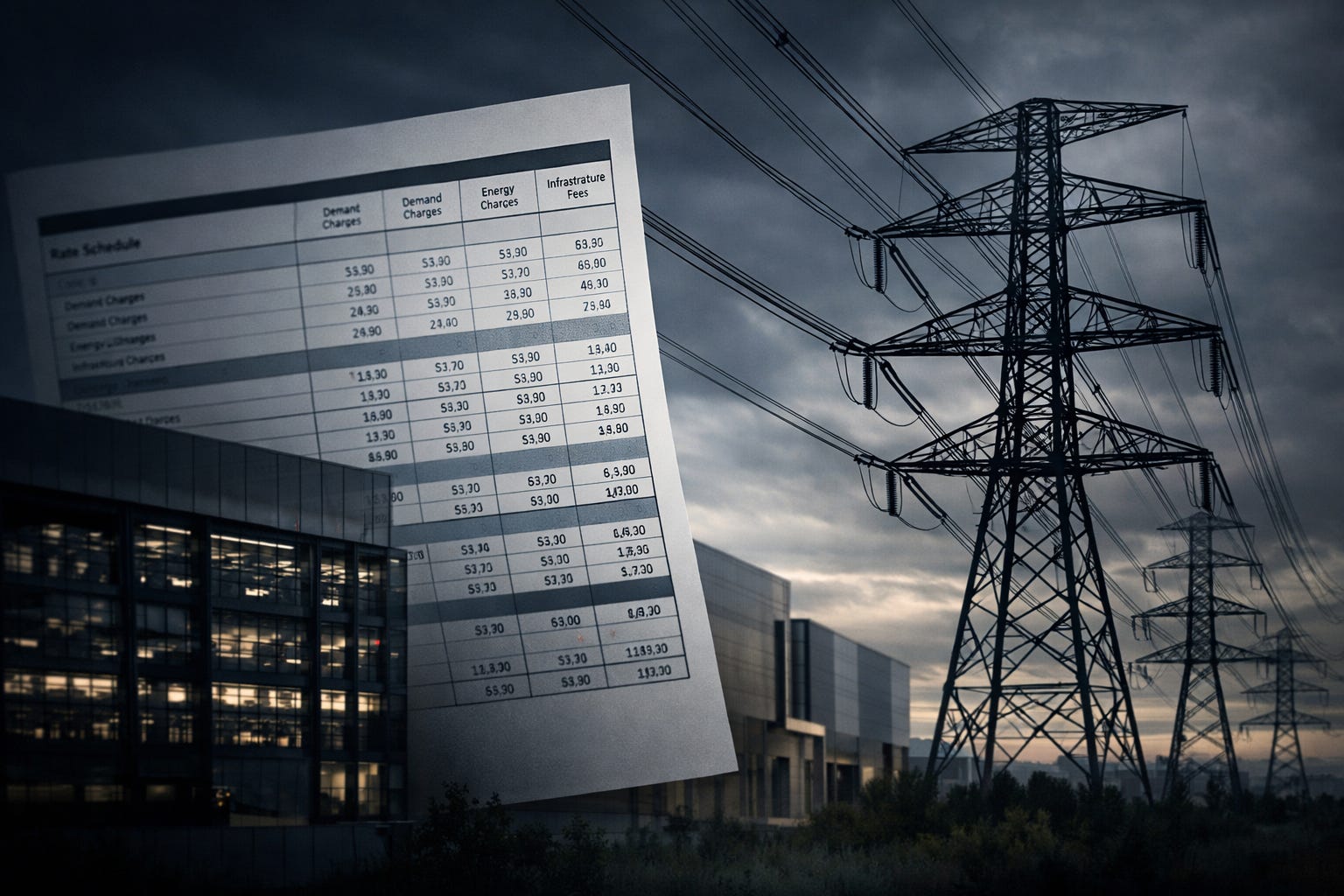
What happens to site underwriting when utilities stop socializing infrastructure costs?
It stops being about cheap land and tax incentives. It starts being about who pays for the wires.
This week, Virginia and Wisconsin quietly moved the conversation from politics to pricing. In Richmond, lawmakers are debating legislation that would shift hundreds of millions of dollars of electricity system costs from residential customers onto data centers served by Dominion Energy. In Milwaukee, We Energies is asking the Wisconsin Public Service Commission to approve a new rate structure specifically for massive data centers under construction in Port Washington and Mount Pleasant.
This is no longer rhetoric about “fair share.” It is tariff redesign.
In Virginia, House Bill 503 would prohibit utilities from passing energy infrastructure costs tied to data centers onto households. Lawmakers have cited projections that residential customers could pay up to $37 more per month by 2040 due to rising electricity demand. The message from Richmond is simple. If infrastructure is built primarily for a 100 megawatt plus facility, that facility should pay for it.
Dominion and Appalachian Power have pushed back, arguing that the State Corporation Commission already approved a new GS-5 high load rate class with 14 year contract terms, minimum demand charges, and exit fees. In other words, the regulatory guardrails are already tightening. Even without new legislation, the direction of travel is clear. Cost causation is being formalized.
In Wisconsin, the numbers are even starker. We Energies told regulators it expects to increase power production by 45 percent over the next five years to serve new data centers. Consumer advocates warned that the OpenAI and Oracle project in Port Washington and the Microsoft facility in Mount Pleasant could ultimately require as much power as all current We Energies customers combined. The utility insists the data centers will pay for new generation, substations, transmission lines, and personnel. The Citizens Utility Board is asking regulators to ensure that promise is enforceable if tech business plans change.
This is the end of the era of socialized AI power.
For years, many developers underwrote data center sites with an implicit assumption. Grid upgrades are long lived assets. Utilities recover costs across a broad base of ratepayers. As long as you sign a power agreement and secure incentives, the incremental infrastructure is part of the system.
That assumption is now fragile.
If Virginia shifts more system costs directly onto high load customers and Wisconsin creates a separate rate class tied explicitly to cost recovery, the underwriting equation changes in three immediate ways.
First, power stops being a simple volumetric pass through. It becomes a capital allocation variable. If the utility builds a gas plant, a transmission line, and a substation primarily for your facility, regulators may require those costs to be allocated directly to you through demand charges, minimum take commitments, collateral requirements, or exit fees. That changes your fixed cost base before the first rack is energized.
Second, the timing risk increases. When tariff structures are under debate, interconnection studies and rate design proceedings become gating events. A project that looked shovel ready can become regulatory dependent. If the Public Service Commission must review cost allocation methodologies in the next rate case, your speed to power is no longer just an engineering schedule. It is a docket number.
Third, political risk is now embedded in pro forma assumptions. In Virginia, 78 percent of voters in a recent poll blamed data centers for rising electricity costs. In Wisconsin, consumer advocates are explicitly warning about an AI bubble that could leave ratepayers stuck with stranded generation. When affordability becomes a campaign issue, utilities and regulators respond. Not slowly. Structurally.
Who is most exposed?
Operators in Northern Virginia served by Dominion who assumed incremental grid investment would be broadly socialized are first in line. Speculative developers without signed hyperscale commitments face even greater exposure, because they cannot easily pass through new cost allocation terms without a contracted tenant. Markets that relied on an economic development narrative to smooth over rate friction are vulnerable if that narrative collides with residential bill pressure.
What breaks first if this continues?
Speed to power breaks first. Tariff redesign forces utilities and regulators to revisit how they evaluate large load applications. Wisconsin is explicitly examining rate structures before approving additional generation. Virginia lawmakers are debating whether infrastructure built primarily for data centers should be paid 95 percent by those facilities. That is not a marginal adjustment. That is a sequencing shift.
Next, lease pricing models break. If you assumed flat or predictable power pass through tied to historic rate structures, and those structures are replaced with high load classes that include minimum demand charges and long term commitments, your tenant economics compress.
Then incentive packages break. Tax abatements negotiated under the assumption of broadly socialized transmission upgrades look different if regulators require direct allocation of capacity costs and reliability investments.
The strategic implication is straightforward. Tariff structure is now a gating variable equal to fiber routes and land entitlements. You can control acreage. You can secure zoning. You cannot assume that the regulatory treatment of megawatts will remain static.
In my own work advising on digital infrastructure sites, I often remind teams that the most expensive mistake is not buying the wrong parcel. It is sequencing incorrectly. Before committing to land, you need to understand not just available megawatts, but the cost allocation framework that will govern them. That is why I developed The 12 Questions Every Real Estate Professional Should Ask Before Advancing a Data Center Site. It is less a checklist and more a discipline. One of those questions now sits at the top of the stack. Who ultimately pays for the wires?
We are entering a phase where regulators are no longer asking whether data centers are good for economic development. They are asking who pays for the grid that makes them possible.
If utilities continue redesigning tariffs around cost causation, the underwriting model for AI infrastructure will look less like a standard industrial lease and more like a project finance transaction tied to specific assets and obligations.
That is not anti growth. It is structural maturity.
And if you are evaluating sites in 2026, it is no longer optional knowledge. It is the first line in your model.
Here is a link to the 12 Questions I reference in the post -> https://fromdirttodata.com/