
The Infrastructure Stack Is Collapsing Into One System

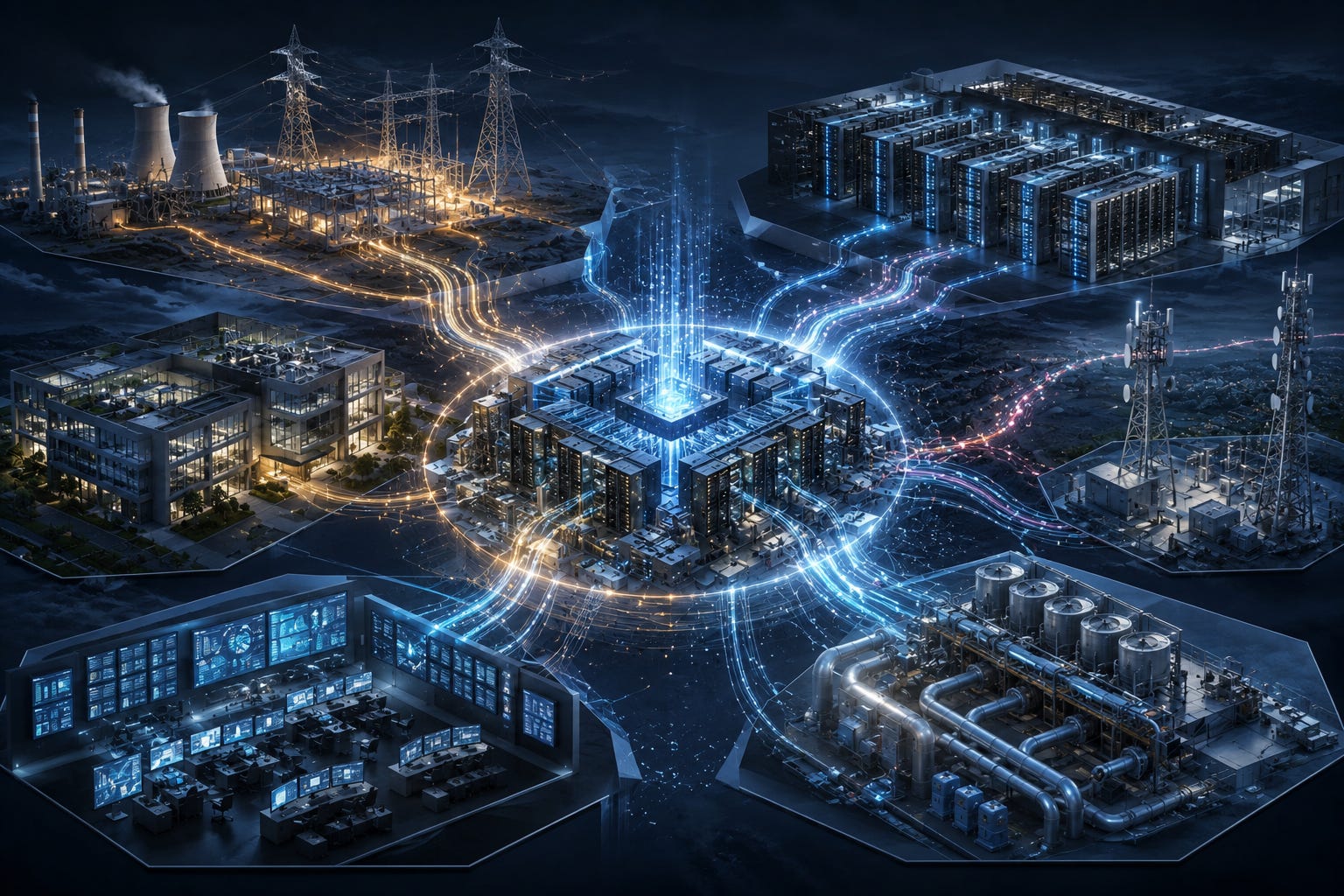
One of the most interesting developments in AI infrastructure is not the scale of the projects being announced.
It is the way those projects are forcing entire industries to converge.
For decades, infrastructure evolved through specialization. Power systems became one discipline. Telecommunications became another. Real estate operated independently. Software platforms developed separately from physical infrastructure. Cooling systems, industrial engineering, operations, networking, and facilities management each developed their own expertise, their own vendors, and often their own organizational silos.
That model worked because the underlying systems could largely be optimized independently.
An electrical engineer could focus on power delivery. A network engineer could focus on connectivity. A facilities team could focus on operations. A software team could focus on applications. While these functions interacted, they remained distinct enough to be managed separately.
AI is beginning to change that.
As AI workloads become larger, denser, and more operationally important, the boundaries between these disciplines are becoming increasingly difficult to maintain. Decisions that once appeared isolated now create consequences throughout the entire infrastructure ecosystem.
The infrastructure stack is collapsing into one system.
The Era of Specialized Infrastructure
Historically, infrastructure was organized around layers.
Utilities generated electricity and delivered it to customers. Telecommunications providers moved information between locations. Data centers supplied space, power, and cooling. Enterprise technology teams managed applications. Building operators maintained facilities. Each layer performed a specific function within a broader ecosystem.
The separation created efficiency.
Organizations could specialize within narrow domains and optimize individual components without necessarily understanding the entire system. A facility could be designed largely independently from the applications eventually running inside it. A network could be expanded without fundamentally changing building operations. A utility could deliver power without understanding the software workloads consuming it.
The boundaries were not perfect, but they were manageable.
The modern AI environment is placing those boundaries under increasing pressure.
Compute Density Changes Everything
The easiest place to see this shift is in compute density.
As computational intensity increases, decisions that once affected only servers now affect nearly every part of the infrastructure stack. Higher rack densities increase cooling requirements. Cooling requirements influence building design. Building design affects power distribution architecture. Power architecture affects utility planning and energy procurement strategies.
What begins as a compute decision quickly becomes an infrastructure decision.
The relationship works in both directions.
Power availability increasingly influences what hardware can be deployed. Cooling limitations shape infrastructure roadmaps. Network design affects cluster architecture. Operational software determines how efficiently resources can be utilized. Each component influences the performance of every other component.
The system can no longer be understood through a single discipline.
From Components to Systems
One phrase appears repeatedly in conversations with operators.
They increasingly describe facilities as systems rather than assets.
That distinction matters.
A traditional real estate mindset often views a building as a collection of components. Power systems, cooling systems, networking equipment, software platforms, and operational processes are treated as individual elements that can be optimized separately. AI infrastructure is forcing operators to think differently.
The performance of the entire facility increasingly depends on the interaction between those elements.
A cooling strategy cannot be evaluated independently from compute density. A networking strategy cannot be separated from workload architecture. Staffing decisions increasingly depend on software automation. Power procurement decisions influence deployment schedules and operational flexibility.
Everything connects to everything else.
Why Software Is Becoming Infrastructure
One consequence of this convergence is that software is becoming increasingly inseparable from physical infrastructure.
Historically, infrastructure and software often occupied different worlds. One involved concrete, steel, mechanical systems, and electrical equipment. The other involved code, applications, databases, and user experiences.
AI infrastructure is erasing that distinction.
Operational software now influences how power is allocated, how cooling systems respond, how workloads move across clusters, how maintenance is scheduled, and how infrastructure performance is optimized. Increasingly, the facility itself behaves like a software-defined environment.
The infrastructure may be physical, but its operation is becoming increasingly digital.
This creates a level of integration that did not previously exist.
Why Telecommunications Is Becoming Part of the Same Conversation
The same convergence is occurring between compute infrastructure and telecommunications.
For many years, networking was often treated as a supporting function. Connectivity was important, but it remained separate from discussions about facilities, power, and operations. AI is making that distinction harder to sustain.
Large-scale AI systems increasingly depend on network architecture.
Latency influences workload performance. Route diversity affects resiliency. Fiber availability influences site selection. Network topology shapes how clusters are designed and deployed. Telecommunications infrastructure is no longer adjacent to the infrastructure conversation.
It has become part of the infrastructure conversation.
The same facility may now be simultaneously evaluated through the lenses of energy, compute, networking, and software operations.
The Rise of the Infrastructure Generalist
One of the less discussed consequences of this shift is its impact on talent.
The industry increasingly needs professionals who can think across multiple layers of the stack simultaneously. Specialists remain critically important, but the ability to understand how different systems interact is becoming increasingly valuable.
Developers must understand energy systems.
Energy professionals must understand compute requirements.
Network operators must understand workload architecture.
Software teams must understand physical constraints.
The most effective operators are often those who can translate between disciplines rather than remaining exclusively within one.
This represents a meaningful shift in how infrastructure expertise is created.
Why AI Infrastructure Looks Different From Traditional Real Estate
Many conversations about AI infrastructure still rely on the language of commercial real estate.
Land, buildings, rents, occupancy, and development costs remain important. Yet the facilities supporting advanced AI increasingly behave less like traditional buildings and more like integrated operational platforms.
Their performance depends on the interaction of energy systems, networking systems, software platforms, cooling architectures, compute environments, and operational processes. Success is not determined by any single component. Success emerges from how effectively the entire system functions together.
This is one reason many AI infrastructure discussions increasingly resemble industrial engineering conversations rather than real estate conversations.
The asset is no longer just the building.
The asset is the system.
The Convergence of Industries
Stepping back, something larger may be occurring.
For decades, society organized infrastructure into separate industries. Utilities managed energy. Telecommunications companies managed networks. Real estate firms developed facilities. Software companies built applications. Industrial operators managed physical systems.
AI is beginning to blur those boundaries.
Energy systems are becoming more connected to compute systems. Compute systems are becoming more dependent on telecommunications infrastructure. Telecommunications networks are becoming more integrated with software platforms. Physical facilities are becoming increasingly software-defined environments.
The result is not merely a larger data center industry.
The result is the gradual convergence of multiple infrastructure sectors into a single operational ecosystem.
The New Infrastructure Stack
The future of AI infrastructure may ultimately be defined by this convergence.
The most successful operators may not be those with the deepest expertise in any single domain. They may be the organizations most capable of integrating multiple domains simultaneously. Competitive advantage increasingly emerges from understanding how energy, cooling, compute, networking, software, and operations interact as a unified system.
This represents a significant departure from how infrastructure has historically been developed and managed.
For decades, the stack was separated into layers.
AI is pulling those layers back together.
The infrastructure stack is collapsing into one system, and the organizations that understand the entire system may be the ones best positioned to shape what comes next.
PLUS: If you want to go deeper:
1. Pressure test a site or opportunity
Looking at a site, powered land opportunity, or development project? If something doesn’t fully add up, reply and share it. I review a small number each week and break down the assumptions, risks, and bottlenecks that matter most.
2. Figure out where you fit
Trying to access real opportunities in digital infrastructure? Reply with “Positioning” and a few lines about your background. I’ll share where I think your skills are most likely to create leverage.
3. Explore a project together
If you’re actively pursuing sites, investments, or infrastructure opportunities and want a clearer framework around power, demand, approvals, and timing, reply with “Work Together” and a brief description of what you’re evaluating.