
Digital Infrastructure Is the New Real Estate

For most of the last century, real estate was the platform on which everything else ran. Cities grew around factories. Offices clustered around transit. Warehouses followed highways and ports. If you controlled land in the right place, the rest tended to follow. Capital flowed in. Infrastructure caught up. Demand filled the space.
That order has flipped.
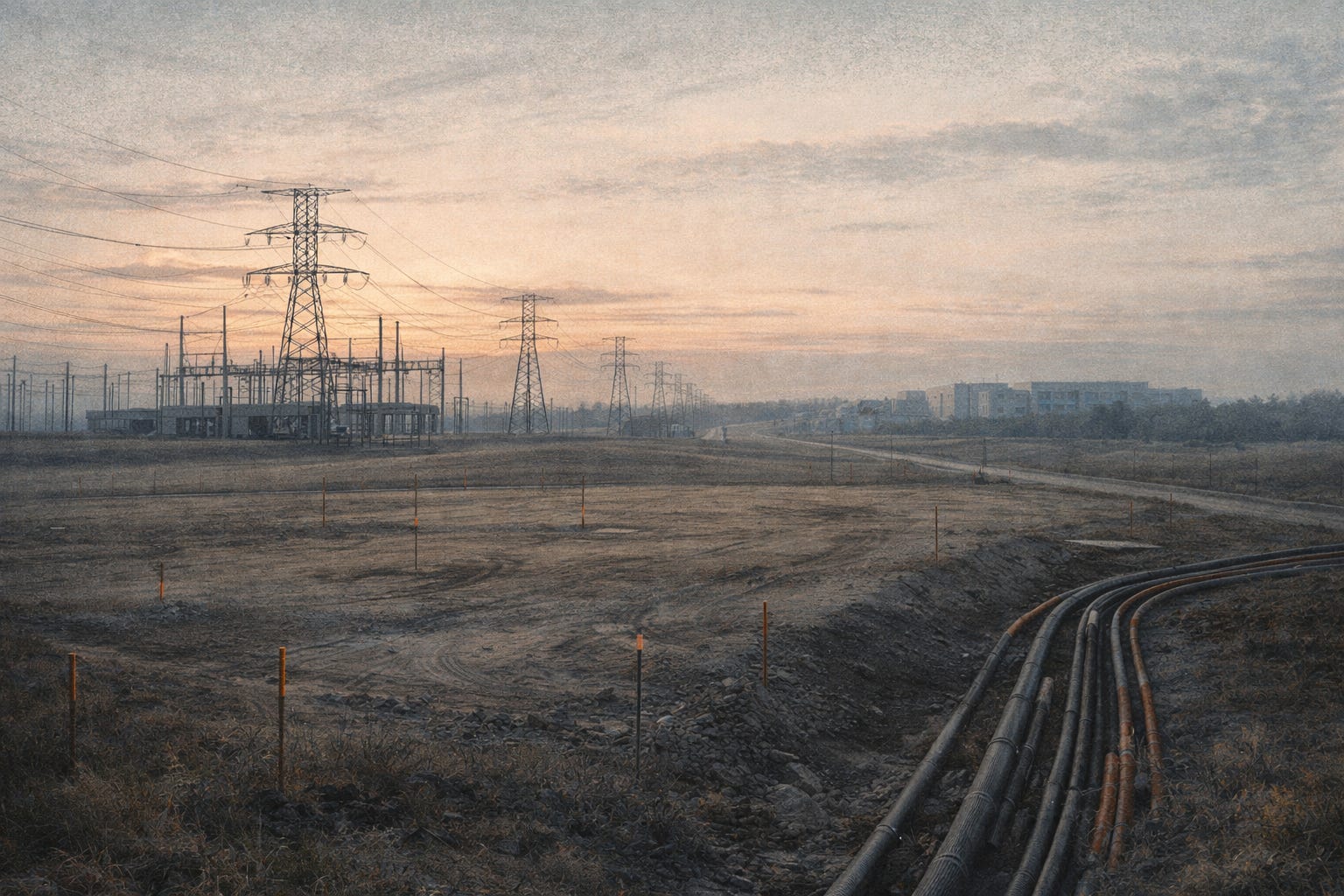
Today, the most consequential development decisions are no longer anchored to where people live or work. They are anchored to where electrons, fiber, and compute can reliably meet. Digital infrastructure has become the new real estate not because it looks like property, but because it now performs the same economic role that land once did. It determines what can exist, where capital goes, and which regions win or lose over time.
This is not a metaphor. It is a reordering of the development stack.
Why Digital Infrastructure Now Sets the Floor
Traditional real estate rewarded control over scarce land. Digital infrastructure rewards control over scarce systems. Power capacity. Interconnection rights. Network adjacency. Cooling feasibility. Regulatory alignment.
These are not features layered onto a project after the fact. They are the preconditions that decide whether a project is viable at all.
A site can be well located, fully entitled, and attractively priced, yet be functionally unusable if the surrounding infrastructure cannot support it on a relevant timeline. Conversely, a modest site with credible access to power and connectivity can outperform far more visible assets.
This is the first diligence shift. Value no longer flows from the building outward. It flows from infrastructure inward.
This shift rests on a simple but often missed distinction. Digital infrastructure does not behave like traditional real estate, even when it occupies land and buildings. I recorded a short explainer that lays out this difference at a decision level, and why applying real estate intuition to infrastructure projects consistently produces error.
Why Digital Infrastructure Is Not Traditional Real Estate
The First Diligence Question: Where Does Power Actually Come From
In traditional real estate, utilities were assumed. They were background services that scaled with growth. In digital infrastructure, power is the project.
Understanding power means understanding generation mix, transmission capacity, interconnection queues, upgrade obligations, and regulatory constraints. It means knowing not just whether power exists nearby, but whether it can be delivered, at what cost, and on what schedule.
This diligence cannot be outsourced to proximity maps or marketing language. It requires engaging the institutions that control allocation and timing. Developers who treat power as an engineering detail rather than a strategic variable misprice risk from the start.
The Second Diligence Question: Who Controls Interconnection and Timing
Interconnection is where digital infrastructure diverges most sharply from real estate intuition.
There is no equivalent in traditional property development to a multi year queue that determines when, or if, a project can operate. Interconnection studies, system impact assessments, and upgrade sequencing introduce uncertainty that capital alone cannot resolve.
The key diligence question is not whether interconnection is possible in theory. It is whether interconnection is probable within a window that aligns with demand, financing, and exit strategy.
Timing is value. Delay is erosion. This is why interconnection has become the silent determinant of winners and losers.
The Third Diligence Question: How Network Topology Shapes Location
Real estate has always been about location. Digital infrastructure is about topology.
Latency, redundancy, and route diversity matter more than proximity to population centers. Fiber backbones, peering points, and network interconnections shape where digital activity can cluster efficiently.
A site that sits on the right network pathways can outperform one that looks superior on a map. This is counterintuitive for many developers trained in physical proximity and demographic analysis.
The diligence mistake is assuming that digital demand behaves like human demand. It does not. It follows physics and network design.
The Fourth Diligence Question: How Governance Replaces Market Signals
As digital infrastructure grows, governance increasingly shapes outcomes.
Utilities operate under regulatory mandates. Grid operators prioritize system stability. Local governments respond to cumulative impacts on communities. None of these actors respond primarily to pricing signals.
This introduces a layer of political and institutional risk unfamiliar to many real estate investors. Approvals can slow. Conditions can change. Priorities can shift.
Understanding governance is now as important as understanding zoning once was. Projects that ignore this reality often discover constraints only after capital is committed.
The Fifth Diligence Question: What Is the Exit If Assumptions Break
Traditional real estate often allowed time to heal mistakes. Leases could roll. Uses could shift. Markets could recover.
Digital infrastructure is less forgiving.
If power is delayed, the asset may not function. If interconnection stalls, revenue may not exist. If network assumptions fail, tenants may never arrive.
Sophisticated actors design exits and pivots early. They structure land control flexibly. They stage capital deployment. They assume some projects will not clear every gate.
This is not pessimism. It is disciplined risk management in a system where infrastructure constraints are real and binding.
What This Means Going Forward
Digital infrastructure is not replacing real estate. It is redefining what real estate means.
Land still matters. Buildings still matter. But they are no longer the primary drivers of value. Infrastructure alignment is.
Regions that understand this will attract investment. Those that do not will watch capital bypass them quietly. Developers who adapt their diligence will build durable portfolios. Those who rely on legacy intuition will struggle to understand why projects stall despite strong demand narratives.
The next era of development will be decided less by who controls the best parcels and more by who understands how systems connect, constrain, and enable growth.
In the digital economy, real estate no longer sets the stage. Infrastructure does.